Bike lean angle on banked roads
A tilted road changes the reference beneath your tyres. The bike’s angle from vertical and its angle relative to the road can therefore tell different stories, even in the same photograph.
Calculated example · ideal physics. All numerical examples use the existing calculator. They describe ideal, steady motion on level ground, not recorded riding data or a safe riding limit. Get development updates
Vertical and road-relative lean
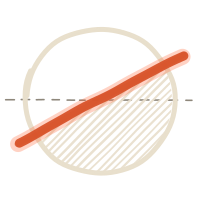
An angle needs a reference. Vertical means the direction defined by gravity. Road-relative lean compares the bike with the local road normal: a direction perpendicular to the surface beneath it. On level ground the references coincide. On a surface that slopes across the path, they differ.
This distinction explains why a bike can look less tilted relative to a banked surface while still leaning toward the inside of its path relative to vertical. A photograph that includes only the local surface may hide that difference. It is also why an angle labelled simply “lean” needs a definition before it can be compared between rides.
What banking changes in the force balance
A banked surface tilts the normal support force. That force can then contribute to the inward acceleration required by the path. OpenStax derives an ideal bank angle for a particular speed and radius without relying on lateral friction. At other speeds, friction is still needed. This ideal case does not establish available tyre grip on a real road.
Do not read a favourable slope as a measured grip margin. The surface, tyre condition and changing slope remain outside the simple calculation. A road that slopes the other way also needs its own force analysis; the flat-road output alone cannot tell you how demanding that situation is.
Use a level-ground example as a reference
| Speed | Path radius | Calculated lean |
|---|---|---|
| 30 km/h | 15 m | 25.3° |
| 30 km/h | 30 m | 13.3° |
These are calculator outputs for level ground and steady motion. The comparison shows what changing radius does in that model. It is not a prediction of road-relative frame lean on a banked surface, and it does not include a road-slope correction.
The calculator has no banking input. Copying its result into a sloped-road comparison without explaining the reference adds a claim the model never made. If you need an actual frame angle, rider position and mounting reference also matter; see bike lean versus body angle.
Why a downhill road is a different question
Banking is slope across the path. A descent is slope along it. The same stretch of road can contain both, and a frame can have roll and pitch at the same time. A photograph of a descent therefore cannot be interpreted just by treating the visible road line as horizontal.
The flat, steady calculator does not model a descent, braking, changing speed or uneven terrain. Keep those conditions with any riding observation. For the underlying relationship used here, read lean angle, speed and radius.
A checklist for comparing two angle readings
- Name the reference: vertical, road normal or camera image.
- Identify what moved: frame, rider or sensor mount.
- Keep speed and path radius from the same moment.
- State whether the road slopes across or along the path.
- Label a calculated value separately from an observed angle.
If one reading uses vertical and the other uses the road, resolve that difference before judging either instrument. Changing a sensor’s zero can make a number look familiar while changing what it means. The measurement guide explains reference and mounting checks.
Sources and calculation
OpenStax: centripetal force and banking · Calculation used in the tables